India’s Fertiliser Dilemma: Self-Reliance Push Signals Policy Reset, but Execution Will Decide Outcomes
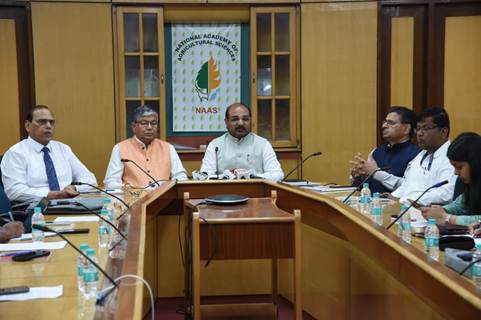
New Delhi, April 15 (BNP): India’s fertiliser policy rarely makes headlines, but the recent brainstorming session by the National Academy of Agricultural Sciences signals something more consequential than routine review. It points to a system under strain—and, more importantly, to a policy establishment that seems ready to rethink its foundations.
For decades, fertilisers have been central to India’s agricultural rise. The gains of the Green Revolution were built on assured access to chemical inputs, especially urea. That model delivered food security. But it also locked India into a structure that is now proving costly, inefficient and environmentally fragile.
At the heart of the problem is dependence. India consumes roughly 33 million tonnes of fertilisers annually, yet relies heavily on imports for key nutrients like phosphorus and potassium. Even urea, often seen as domestically secure, is tied to global markets through imported natural gas.
This leaves the country vulnerable to geopolitical shocks and price swings. Recent global disruptions have made that vulnerability hard to ignore. Fertiliser security is no longer a technical concern. It is a strategic one, sitting alongside food and energy security.
The fiscal burden reflects this reality. A subsidy bill of ₹1.71 lakh crore is not just a budgetary line item; it is the cost of sustaining an increasingly inefficient equilibrium.
The bigger issue is not just how much India imports, but how it uses what it imports.
Subsidy structures have long favoured nitrogen, particularly urea, leading to a skewed nutrient balance. Farmers, responding rationally to price signals, overapply nitrogen while underusing other essential nutrients. The result is declining soil health and diminishing productivity gains.
Low nutrient-use efficiency compounds the problem. A significant share of fertilisers never reaches the crop, lost instead to the air, water or soil processes. This raises costs for farmers and creates environmental damage that policy has historically overlooked.
In effect, India is spending more each year to get less out of its soils.
What makes the NAAS discussions noteworthy is not just the diagnosis, but the willingness to consider structural change.
Bringing urea under a nutrient-based subsidy regime would be a major departure from the current system. So would linking subsidies to soil health metrics or moving toward direct benefit transfers. These ideas have circulated before, but rarely with this level of institutional backing.
Together, they suggest a shift from input-centric policy to outcome-oriented policy—where the goal is not just to provide fertilisers, but to ensure they are used efficiently and sustainably.
The push for Integrated Nutrient Supply and Management (INSAM) reinforces this direction. Replacing a quarter of mineral fertilisers with organic alternatives within three years is an ambitious target. More importantly, it reflects a conceptual shift: from dependence on chemical inputs to a more balanced nutrient ecosystem.
Technology is expected to play a central role in this transition. Precision agriculture tools, AI-driven advisories and sensor-based systems could help farmers apply the right nutrients in the right quantities at the right time.
This matters because India’s agricultural extension system has historically emphasised increasing input use rather than optimising it. Digital platforms offer a chance to correct that imbalance by delivering tailored, real-time guidance at scale.
But technology is not a silver bullet. Adoption will depend on affordability, usability and trust—factors that have limited the impact of past innovations.
If the direction is becoming clearer, the path remains uncertain.
Fertiliser reform, particularly around urea, has long been politically sensitive. Any attempt to rationalise subsidies risks immediate resistance from farmers, even if the long-term benefits are clear.
Similarly, scaling organic inputs and bio-fertilisers requires more than policy targets. It demands reliable supply chains, quality assurance and behavioural change at the farm level. Farmers will shift practices only if they see consistent results.
This is where many well-intentioned reforms falter—not in design, but in execution.
What makes this moment different is the convergence of pressures. Fiscal constraints, environmental degradation and global supply risks are all pushing in the same direction. That alignment creates a window for reform that is both rare and time-bound.
The NAAS roadmap does not offer quick fixes. Instead, it outlines a transition—away from a subsidy-heavy, input-driven system toward one that prioritises efficiency, resilience and soil health.
Whether that transition succeeds will depend less on policy announcements and more on coordination: across ministries, between Centre and states, and most critically, with farmers themselves.
India’s next agricultural transformation will not be about producing more at any cost. It will be about producing better, with fewer resources and greater resilience. The fertiliser debate is where that shift is beginning to take shape.
