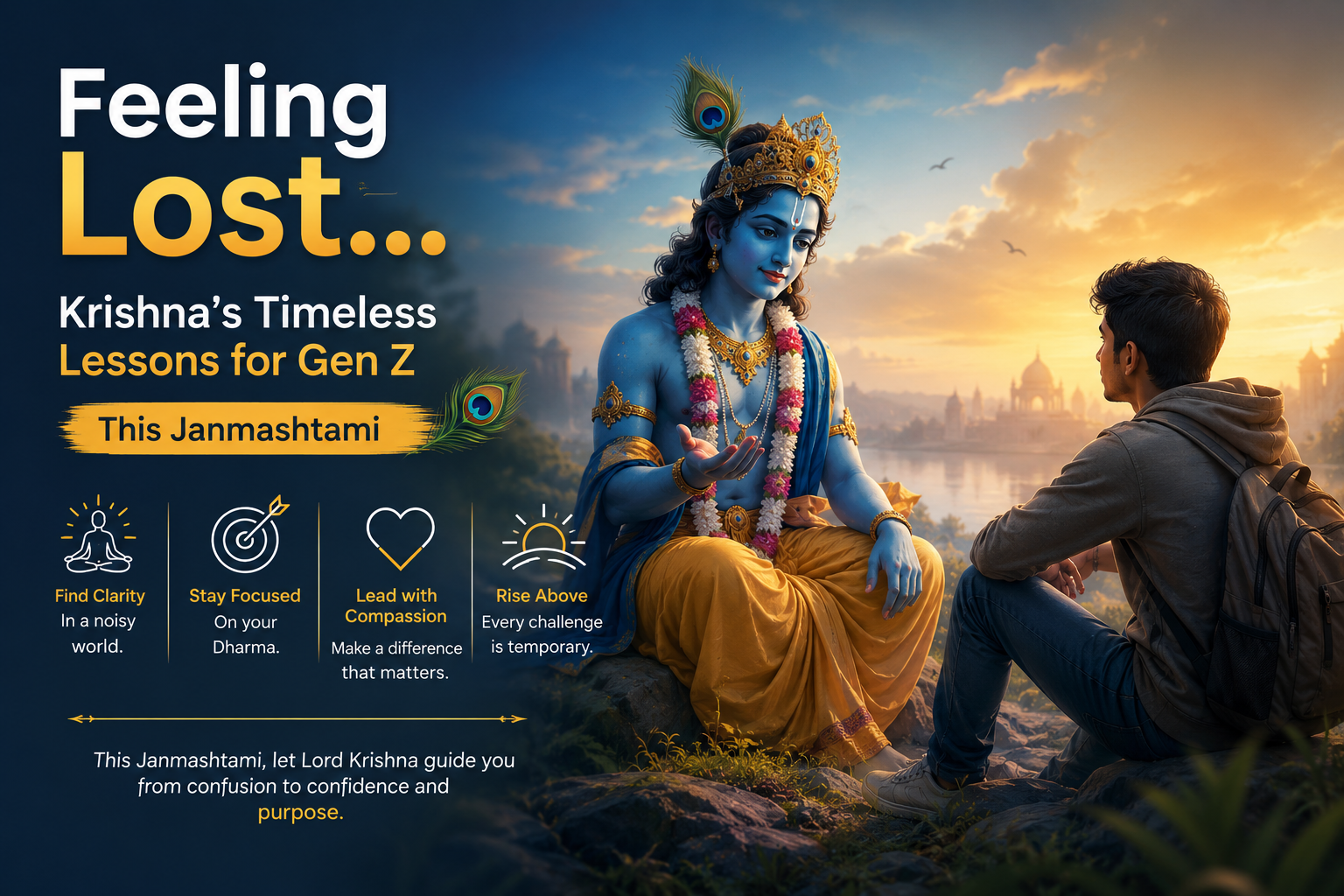
Feeling Lost… Krishna’s Timeless Lessons for Gen Z This Janmashtami
Sept 03: There is a particular kind of uncertainty that defines growing up today: having more choices than ever, yet still wondering if you are choosing the right one. Career paths keep changing, social media makes everyone else’s life look ahead of yours, and artificial intelligence is reshaping the meaning of work almost overnight. For Gen Z, feeling lost does not always come from having no options; sometimes, it comes from having too many.
That feeling is not entirely new. Thousands of years ago, Arjuna stood at his own crossroads, overwhelmed by doubt and unsure of what the right path looked like. Krishna did not hand him an easy answer. Instead, through the Bhagavad Gita, he offered a way to think about action, purpose, failure, self-discipline and inner balance. This Janmashtami, those timeless ideas can offer Gen Z something surprisingly relevant: not a perfect roadmap for life, but a different way of finding direction when the road ahead feels uncertain.
A New Generation Is Redefining What Success Means
For Gen Z, success is increasingly about more than a job title, a bigger salary or a picture-perfect career. The question is slowly shifting from “How successful can I become?” to “Does the life I am building actually mean something to me?”
Financial security still matters, but so do meaningful work, personal growth, freedom, relationships and well-being. Many young people are beginning to question the idea that success has to follow a single path or come with a particular title.
That search for meaning makes Krishna’s conversation with Arjuna especially relevant. Before deciding where life should take us, perhaps we first need to understand what matters to us, what we are capable of, and why we are choosing a particular path.
You Are Allowed to Not Have It All Figured Out
There is enormous pressure to know exactly what you want at a young age.
The right degree. The right job. The right city. The right relationship. The right lifestyle.
But uncertainty does not necessarily mean you are failing.
Arjuna’s hesitation reminds us that even important decisions can come with confusion. The important part is not pretending the confusion is not there, but learning how to think through it.
For Gen Z, that could mean giving yourself permission to change direction.
A first job does not have to become a lifelong career. A failed idea does not have to end your ambition. Taking time to understand yourself does not mean you are falling behind.
Sometimes, clarity comes after you start moving.
Focus on the Work You Can Actually Control
One of Krishna’s most discussed teachings appears in Bhagavad Gita 2.47, where the focus is placed on action rather than attachment to the fruits of action. The teaching is not a rejection of results; it is a reminder that our control lies primarily in what we do. (Gita Supersite, IIT Kanpur)
That idea feels remarkably practical today.
You can prepare for an interview. You cannot control the hiring decision.
You can study. You cannot control every question in the examination.
You can create something you believe in. You cannot control how many people will see it.
You can give your best to a relationship. You cannot control another person’s choices.
Doing your best while accepting that the outcome is not entirely yours to command can take some of the pressure out of everyday life.
Your Timeline Is Not Everyone Else’s Timeline
Social media has made comparison almost effortless.
One person is travelling.
Another has launched a business.
Someone else has a dream job.
Someone appears to have found love, financial success and a perfect lifestyle before turning 25.
But we rarely see the uncertainty behind those pictures.
Krishna’s emphasis on one’s own path offers a useful counterpoint to this culture of comparison.
Your journey does not need to resemble someone else’s.
You can admire another person’s success without turning it into evidence that you are unsuccessful.
There is no universal schedule for becoming who you want to be.
Detachment Does Not Mean You Stop Caring
Detachment is one of those ideas that can easily be misunderstood.
It does not necessarily mean becoming distant, indifferent or emotionless.
It can mean caring deeply without allowing an outcome to completely control you.
Work hard without making your job title your identity.
Build a business without deciding your self-worth from its revenue.
Create content without allowing likes to determine whether your creativity has value.
Love people without believing you can control their choices.
In a world built around instant feedback, that kind of emotional independence can be powerful.
Career Choices Need Purpose Too
For Gen Z, the workplace is changing rapidly.
Artificial intelligence is transforming the way people work, new roles are emerging, and traditional career paths are becoming less predictable. The idea of staying in one profession for an entire career is also becoming less common.
In this changing environment, choosing a career is not simply about finding the highest-paying job. It is also about understanding what you are good at, what keeps you curious and what kind of work feels meaningful.
Instead of asking only, “What job will give me the most money?” it may be worth asking:
“What kind of work allows me to use my abilities, keep learning and build a life that reflects what matters to me?”
Krishna’s teachings offer an interesting perspective here. The Bhagavad Gita places importance on performing one’s duty with sincerity rather than becoming consumed by the rewards attached to it.
Your career path may change. Your priorities may change. Even your definition of success may change.
And that is okay. Finding the right direction does not always mean knowing exactly where you will end up. Sometimes, it simply means understanding what matters to you now and taking the next step with purpose.
Not Every Battle Deserves Your Energy
The internet has made reacting incredibly easy.
Someone disagrees with you.
A stranger leaves a nasty comment.
A colleague says something you dislike.
Suddenly, a five-minute irritation has taken up your entire evening.
Krishna’s guidance to Arjuna is not simply about what action to take. It is also about acting with awareness rather than being controlled by confusion and impulse.
For Gen Z, that can mean learning when to engage and when to step away.
Not every criticism deserves a response.
Not every disagreement needs to become an argument.
And not every opinion deserves a place in your head.
Protecting your attention is becoming a form of self-discipline.
Motivation Will Come and Go. Discipline Has to Stay.
Modern culture is obsessed with motivation.
There is always another productivity video telling us to wake up earlier, work harder and become the best version of ourselves.
But motivation is unpredictable.
Some days you will feel inspired.
Other days, you will not.
That is when discipline matters.
The Gita’s teachings repeatedly return to self-control, steadiness and disciplined action.
Sometimes discipline looks very ordinary.
Finishing the assignment.
Going back to the business idea.
Practising the skill again.
Putting your phone away for an hour.
Showing up even when nobody is applauding.
Progress is often built in these quiet moments.
Failure Is Something You Experience, Not Who You Are
Gen Z lives in a world of visible numbers.
Grades.
Followers.
Views.
Salary packages.
Engagement.
Performance scores.
It is easy for those numbers to become identities.
A rejected application can start to feel like “I am not good enough.”
A failed business can become “I am a failure.”
A low grade can turn into “I am not smart.”
But an outcome is not the same thing as an identity.
Failure can hurt. It can be disappointing, embarrassing and sometimes difficult to accept. But it can also show you what needs to change, where you need to grow or when it is time to take a different direction.
A failed attempt does not erase your abilities. A rejection does not decide your future. One bad result cannot tell the entire story of your life.
Failure can teach you.
It can redirect you.
It can make you stronger.
But it does not have to define you.
Don’t Let an Algorithm Tell You What Your Life Should Look Like
Algorithms are designed to keep our attention.
They show us what is popular, what people are buying and what others are watching.
But popularity is not the same as purpose.
If everyone is chasing a particular career, does that mean you should?
If everyone is buying something, do you actually want it?
If everyone seems to be living a particular lifestyle, does it fit your reality?
Krishna’s teachings encourage discernment — the ability to look beyond immediate impulses and consider what genuinely matters.
In an attention economy, knowing what not to chase can be just as important as knowing what to pursue.
Emotional Balance Is Not the Same as Being Emotionless
Nobody expects a young person to never feel angry, jealous, disappointed or afraid.
Those emotions are part of being human.
The challenge is learning not to let every emotion make the next decision.
Someone leaves your message unanswered.
You feel rejected.
Someone gets the opportunity you wanted.
You feel jealous.
Your work receives criticism.
You feel angry.
The emotion is real.
But the reaction does not have to be automatic.
The Gita’s idea of steadiness offers a reminder to create some space between what happens to us and what we choose to do next.
That space can change a decision.
Relationships Still Need Real Presence
Technology can keep people connected.
It cannot automatically make relationships meaningful.
Friendship still needs listening.
Family still needs time.
Love still needs trust.
And being there for someone still matters.
Krishna is remembered through many different relationships — as friend, guide, companion and teacher.
Janmashtami can therefore also be a moment to look at the quality of our own connections.
How often are we actually listening rather than simply replying?
How often are we present without looking at our phones?
How often do we make time for people without expecting anything in return?
Sometimes the most meaningful connection is the one that never appears on a screen.
You Don’t Have to Turn Your Entire Life Into a Hustle
There is a strange pressure today to make every moment productive.
Learn a new skill.
Start a side hustle.
Build a personal brand.
Network.
Work longer.
Wake up earlier.
Do more.
But a meaningful life cannot be measured only by output.
Deloitte’s research reinforces the fact that Gen Z’s definition of career satisfaction extends beyond traditional advancement, with purpose, well-being, learning and financial security all playing important roles.
Krishna’s teachings similarly invite us to think about the quality and purpose of our actions, not simply how much we accomplish.
Being busy is not the same as moving in the right direction.
AI Can Give You Answers. It Cannot Choose Your Values.
This may be one of the most important questions for Gen Z.
Artificial intelligence can suggest careers, write applications, analyse information, generate ideas and help people make decisions.
But it cannot decide what matters most to you.
It can provide possibilities.
You still have to choose.
Deloitte’s 2025 research found that 74% of Gen Z respondents globally expected GenAI to affect the way they work within the following year.
As technology becomes better at answering questions, human judgement may become even more important.
Krishna’s conversation with Arjuna is ultimately about helping a confused person understand his situation and act with greater clarity.
That distinction matters in the AI era.
Technology can assist with the “how.”
We still have to wrestle with the “why.”
Maybe Purpose Matters More Than Productivity
A productive life is not necessarily a meaningful life.
You can achieve everything on your checklist and still wonder why you are doing it.
You can earn well and still feel disconnected.
You can become successful and still feel lost.
Purpose asks a different question.
Not, “How much can I accomplish?”
But, “What am I accomplishing this for?”
For a generation entering a rapidly changing world of work, that question may become increasingly important.
Janmashtami Can Be a Moment to Pause
Janmashtami is celebrated through prayers, fasting, devotional music, temple rituals, cultural performances and the midnight observance of Krishna’s birth. Mathura and Vrindavan remain closely associated with the festival and Krishna’s story.
But the festival can also become a moment of personal reflection.
This Janmashtami, Gen Z could ask:
Am I choosing my path or simply following what everyone else is doing?
Am I allowing social media to decide how I measure myself?
Can I work hard without becoming obsessed with recognition?
Can I handle failure without turning it into a judgement on my worth?
What deserves my attention?
What can I let go of?
There may not be easy answers.
But asking the questions is a start.
Krishna’s Wisdom Was Never a Promise of an Easy Life
The Bhagavad Gita does not promise Arjuna a life without difficult choices.
Krishna does not tell him that everything will happen exactly as he wants.
Instead, he helps him understand how to face a difficult situation.
That may be the most relevant lesson for Gen Z.
The future will remain uncertain.
Careers will change.
Technology will evolve.
Plans will fail.
People will surprise us.
Opportunities will appear when we least expect them.
We cannot control all of it.
But we can decide how we respond.
The Direction May Begin With You
Perhaps Krishna’s greatest lesson for a generation feeling lost is not a formula for finding the perfect life.
It is learning how to move through an imperfect one.
Do the work.
Know what matters.
Do not let comparison consume you.
Learn from failure.
Stay grounded when things go well.
Protect your attention.
Question what the world tells you to want.
And when you genuinely do not know what comes next, give yourself permission to pause.
This Janmashtami, Krishna’s story can be more than something we celebrate.
It can be something we reflect on.
Because finding direction does not always mean knowing exactly where you will end up.
Sometimes, it simply means knowing what you stand for — and having the courage to take the next step.